


Market Overview:
The formic acid market is experiencing rapid growth, driven by growing mental health awareness, telehealth and remote monitoring, and technological integration and ai. According to IMARC Group's latest research publication, "Formic Acid Market Size, Share, Trends, and Forecast by Type, Application, End Use, and Region, 2025-2033", The global formic acid market size was valued at 944.91 Kilo Tons in 2024. Looking forward, IMARC Group estimates the market to reach 1,216.45 Kilo Tons by 2033, exhibiting a CAGR of 2.82% during 2025-2033.
This detailed analysis primarily encompasses industry size, business trends, market share, key growth factors, and regional forecasts. The report offers a comprehensive overview and integrates research findings, market assessments, and data from different sources. It also includes pivotal market dynamics like drivers and challenges, while also highlighting growth opportunities, financial insights, technological improvements, emerging trends, and innovations. Besides this, the report provides regional market evaluation, along with a competitive landscape analysis.
Grab a sample PDF of this report: https://www.imarcgroup.com/formic-acid-market/requestsample
Our report includes:
- Market Dynamics
- Market Trends And Market Outlook
- Competitive Analysis
- Industry Segmentation
- Strategic Recommendations
Factors Affecting the Growth of the Formic Acid Industry:
- Growing Leather Industry
The robust expansion of the global leather industry, particularly in developing economies experiencing increased consumer spending on leather goods like footwear, apparel, and accessories, is a significant driver for the formic acid market. Formic acid plays a crucial role in various stages of leather processing, most notably in the deliming and pickling processes, which are essential for preparing hides and skins for tanning. As the demand for leather products continues to rise, the consumption of formic acid in leather manufacturing is also projected to increase substantially throughout the forecast period of 2025-2033. This direct correlation between the growth of the leather industry and the demand for formic acid underscores its importance as a key chemical in this sector. Furthermore, the increasing focus on sustainable leather processing methods is also influencing the demand for formic acid, as it is considered a more environmentally friendly alternative to some other acids traditionally used in leather treatment.
- Agricultural Applications Surge
The escalating adoption of formic acid in diverse agricultural applications is emerging as a potent market dynamic. In the agricultural sector, formic acid is increasingly utilized as a silage preservative, effectively inhibiting the growth of undesirable bacteria and molds, thus ensuring the quality and nutritional value of stored animal feed. This is particularly relevant in regions with intensive livestock farming. Furthermore, formic acid finds application as an insecticide and acaricide, particularly in apiculture for controlling Varroa mites in bee colonies, which are crucial for pollination and agricultural productivity. The growing emphasis on sustainable agriculture and the need to minimize post-harvest losses are driving the demand for effective and environmentally sound solutions like formic acid. Ongoing research into new agricultural applications, such as soil treatment and crop protection, further suggests a strong growth trajectory for formic acid in this sector over the coming years.
- Chemical Synthesis Importance
Formic acid's pivotal role as a fundamental building block and intermediate in a wide array of chemical synthesis processes is a critical factor propelling its market growth. It is extensively used in the production of various chemicals, including pharmaceuticals, dyes, rubber chemicals, and textile auxiliaries. As the global chemical industry continues to expand, driven by increasing demand from downstream sectors, the consumption of formic acid as a key raw material is also expected to witness significant growth. Moreover, ongoing research and development efforts are constantly exploring new applications for formic acid in chemical synthesis, including its potential in the production of biofuels and other value-added chemicals. This versatility and its essential nature in numerous chemical processes ensure a stable and growing demand for formic acid in the global market, making it a crucial component of the broader chemical manufacturing landscape throughout the forecast period and beyond.
Leading Companies Operating in the Global Formic Acid Industry:

- BASF SE
- Chongqing Chuandong Chemical Group Co. Ltd.
- Eastman Chemical Company
- Gujarat Narmada Valley Fertilizers & Chemicals
- Luxi Group Co. Ltd.
- Perstorp Holding AB (PETRONAS Chemicals International B.V.)
- Shandong Acid Chemicals Co. Ltd.
- Thermo Fisher Scientific.
Formic Acid Market Report Segmentation:
Breakup By Type:
- Grade 85%
- Grade 94%
- Grade 99%
- Others
Grade 85% represents the largest segment as it is widely used in various industrial applications due to its high purity and effectiveness.
Breakup By Application:
- Animal Feed and Silage Additives
- Leather Tanning
- Textile Dying and Finishing
- Intermediary in Pharmaceuticals
- Others
Animal feed and silage additives account for the majority of the market share due to the increasing demand for high-quality feed additives to improve livestock health and productivity.
Breakup By End Use:
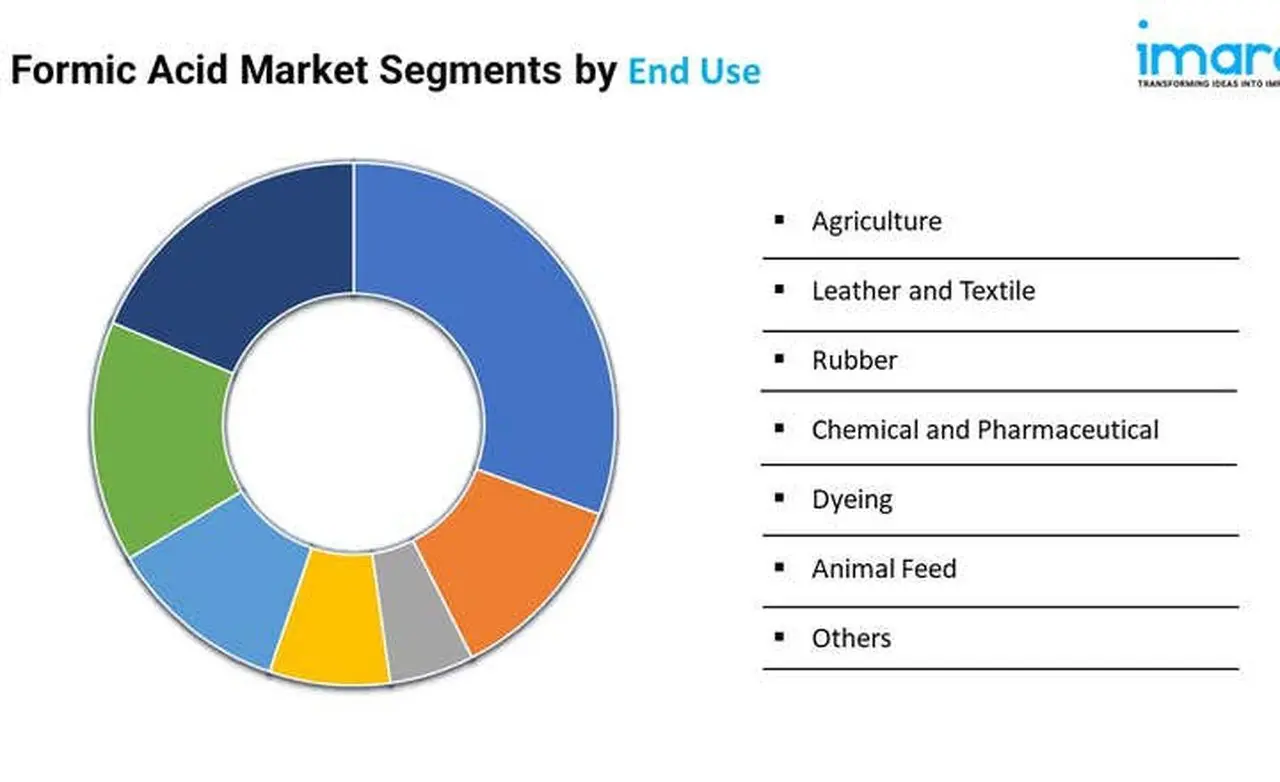
- Agriculture
- Leather and Textile
- Rubber
- Chemical and Pharmaceutical
- Dyeing
- Animal Feed
- Others
Agriculture holds the biggest market share as formic acid is extensively used in agriculture for purposes, such as preserving feed grains, controlling bacterial growth, and enhancing crop yields.
Breakup By Region:
- North America (United States, Canada)
- Asia Pacific (China, Japan, India, South Korea, Australia, Indonesia, Others)
- Europe (Germany, France, United Kingdom, Italy, Spain, Russia, Others)
- Latin America (Brazil, Mexico, Others)
- Middle East and Africa
Asia Pacific enjoys the leading position in the formic acid market due to factors, such as rapid industrialization, increasing agricultural activities, and a growing demand for leather and textiles in countries like China and India.
Research Methodology:
The report employs a comprehensive research methodology, combining primary and secondary data sources to validate findings. It includes market assessments, surveys, expert opinions, and data triangulation techniques to ensure accuracy and reliability.
Note: If you require specific details, data, or insights that are not currently included in the scope of this report, we are happy to accommodate your request. As part of our customization service, we will gather and provide the additional information you need, tailored to your specific requirements. Please let us know your exact needs, and we will ensure the report is updated accordingly to meet your expectations.
About Us:
IMARC Group is a global management consulting firm that helps the world’s most ambitious changemakers to create a lasting impact. The company provide a comprehensive suite of market entry and expansion services. IMARC offerings include thorough market assessment, feasibility studies, company incorporation assistance, factory setup support, regulatory approvals and licensing navigation, branding, marketing and sales strategies, competitive landscape and benchmarking analyses, pricing and cost research, and procurement research.
Contact Us:
IMARC Group
134 N 4th St. Brooklyn, NY 11249, USA
Email: [email protected]
Tel No:(D) +91 120 433 0800
United States: +1-631-791-1145